About the Vancouver Fibreshed
The Vancouver Fibreshed is a regional affiliate of the global Fibershed movement. We work to create and nourish the fibre system on mainland British Columbia within 300 kilometres of downtown Vancouver by supporting the farmers, producers, and makers working with local fibre, local natural dyes, and local labour, with the goal of building a thriving regional textile economy.
What is a Fibreshed?
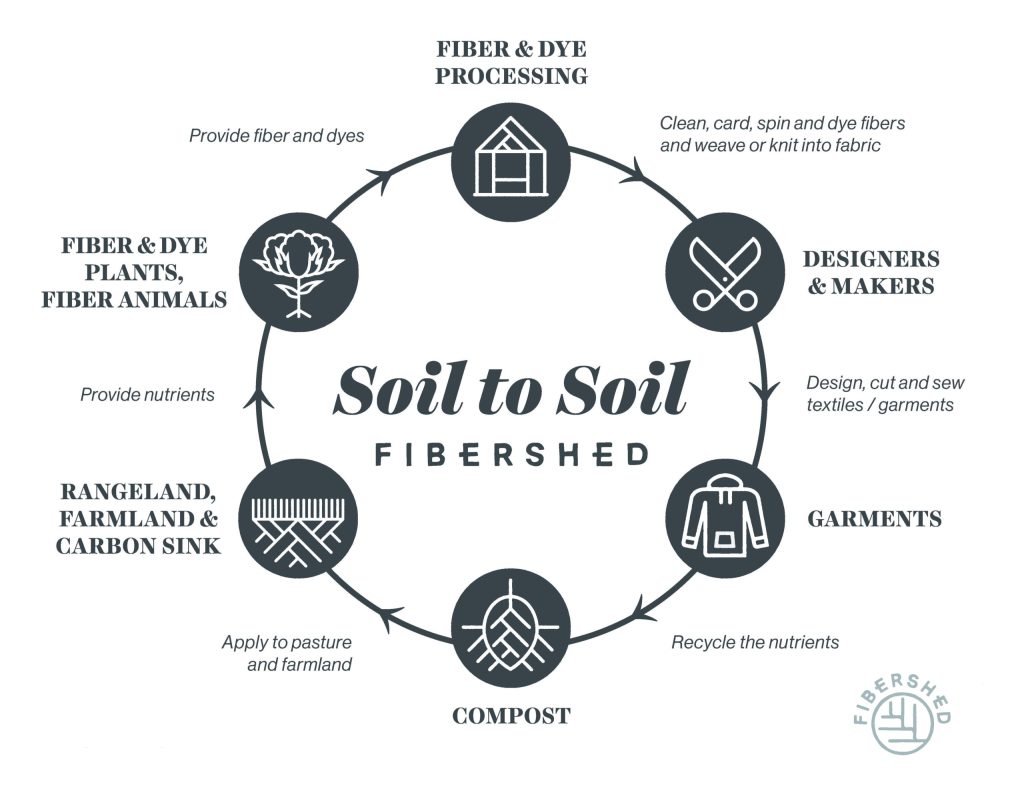
The international Fibershed project was founded in 2010 by Rebecca Burgess out of a desire to reduce her own ecological footprint and develop a wardrobe comprised of materials and labour sourced from the surrounding region. A fibreshed, like a watershed, refers to a geographical region containing fibre resources, as well as fibre artists and artisans, designers, and processors that form a network of exchange and relationships.
As an affiliate to the original Fibershed located in Northern and Central California, USA, we are part of an international grassroots network that promotes the development of regional fibre systems and communities, which in turn expand opportunities to implement climate-beneficial agriculture, rebuild regional manufacturing, and educate the public about the benefits of soil-to-soil textile systems.
History of the Vancouver Fibreshed
The Vancouver Fibreshed (VFS) was founded in 2014 by Emily Huizenga (née Smith). Under her leadership, the VFS helped cultivate early conversations and education around regional textile systems and emphasized the importance of connecting farmers, fibre artists, designers, and educators across the Lower Mainland of British Columbia.
The founding years involved a number of meet-ups, mapping events, and community town halls to bring together as many makers and producers. Those conversations generated community projects and networks that ultimately led to curriculum shifts in fashion and design schools in Vancouver. In collaboration with Emily Carr University’s Shumka Centre for Creative Entrepreneurship, Aboriginal Gathering Place and Textile Adaptations Research Program (TARP) Lab, Emily created a Fibreshed Field School which ran from 2020-2021. It consisted of two phases which began with the field school program in the fall of 2020, and a dissemination phase in 2021, where students created a publication and podcast inspired by the Field School.
Emily continues to be actively involved in education and creative practice informed by Fibreshed principles, with her current work and research shared through her platform, Random Acts of Making.
In 2026, the Vancouver Fibreshed entered a new chapter as Emily passed leadership of the VFS to Vanessa Ferronato, Mhicaella Lopez, and Maddy Prevost. Together, they are working to reawaken the VFS as a working group of EartHand Gleaners, drawing on the shared goals and passions of both organizations while honouring its original vision and evolving it to meet the needs of today’s fibre and textile landscape.
EartHand has always been about connecting local makers to local materials here in our urban setting. A fibreshed cannot exist without relationships of mutual respect and support – respect for the land, the plants and animals, the stewards and farmers, and numerous skill holders that participate in creating a functioning community.
In Vancouver, BC, beyond the public parks where we grow materials for use, EartHand also partners with Russel Farms and other community groups, universities, and municipalities in creating their own access to materials.
We are thrilled to be able to share, as a resource, this document created by artist Anna Heywood Jones as part of her time as an artist in residence in 2022. This PDF is an archive and library of what local cloth in our fibreshed can look like.
Our Geographic Region
Located on the mainland of British Columbia within a ~300km radius of Vancouver’s downtown core.
Our neighbouring fibresheds include the Vancouver Island Fibreshed, the Sunshine Coast Fibreshed, and the West Kootenay Fibreshed.
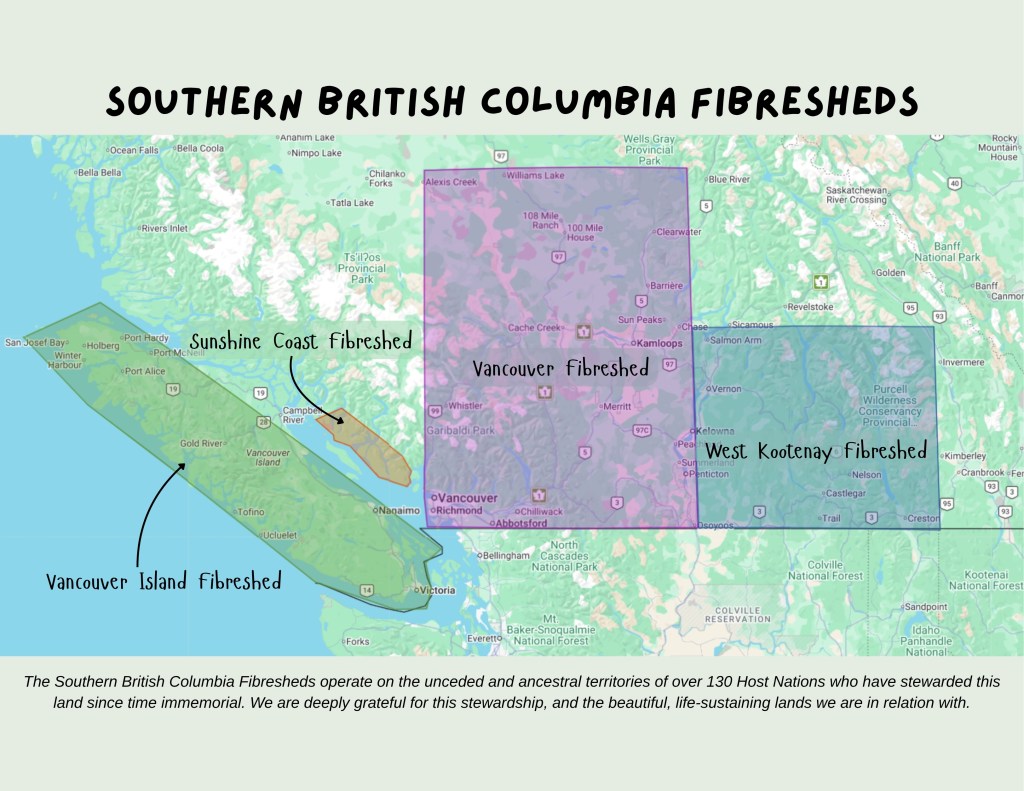
The Vancouver Fibreshed operates on the unceded and ancestral territories of over eighty indigenous host nations. We are deeply grateful for this stewardship since time immemorial, and to be here alongside host nations on these beautiful, life-sustaining lands and waterways.
Lower Mainland Southwest Nations
- Aitchelitz First Nation
- Boothroyd Indian Band
- Boston Bar First Nation
- Cayoose Creek
- Chawathil First Nation
- Cheam First Nation
- Katzie First Nation
- Kwantlen First Nation
- Kwaw-kwaw-a-pilt First Nation
- Kwikwetlem First Nation
- Leq’a: mel
- Lil’wat Nation
- Matsqui
- Musqueam Nation
- N’Quatqua
- Peters First Nation
- Popkum
- Samahquam
- Seabird Island
- Semiahmoo
- Shxw’ow’hamel First Nation
- Shxwhá:y Village
- Skatin Nations (Skookumchuck)
- Skawahlook First Nation
- Skowkale
- Skwah First Nation
- Soowahlie
- Spuzzum First Nation
- Sq’ewlets
- Squamish
- Squiala First Nation
- Sts’ailes
- Sumas First Nation
- T’it’q’et
- Ts’kw’aylaxw First Nation
- Tsawwassen First Nation
- Tsleil Waututh Nation
- Tzeachten
- Union Bar
- Xa’Xtsa (Douglas First Nation)
- Xaxli’p First Nation
- Xwísten (Bridge River Indian Band)
- Yakweakwioose
- Yale First Nation
Thompson Okanagan Nations
- Adams Lake Indian Band
- Ashcroft Indian Band
- Bonaparte First Nation
- Coldwater Indian Band
- Cook’s Ferry Indian Band
- Kanaka Bar
- Lower Nicola
- Lower Similkameen
- Lytton
- Neskonlith Indian Band
- Nicomen
- Nooaitch Indian Band
- Okanagan Indian Band
- Oregon Jack Creek
- Osoyoos
- Penticton
- Shackan
- Simpcw First Nation
- Siska
- Skeetchestn
- Skuppah
- Skwlax te Secwepemculecw
- Splatsin
- Tk̓emlúps te Secwépemc
- Tsal’alh First Nation
- Upper Nicola
- Upper Similkameen
- Westbank First Nation
- Whispering Pines/Clinton
Cariboo Nations
At the Vancouver Fibreshed, we recognize the role textiles play in the settler colonization of Turtle Island, and in our fibreshed region. Settlers grew fibre plants, and raised fibre animals on land stolen from Indigenous nations, contributing to colonial nation-building projects; this dispossession is ongoing in our region, on Turtle Island, and around the world. We cannot undo that history, but rather stay with the trouble of this colonial legacy, and seek ways to align our mission and activities with decolonial projects.
Vancouver Fibreshed Fundraiser
The Vancouver Fibreshed Fundraiser is an optional way to give a little extra support toward building our regional fibre system. Your generosity helps seed early projects, gatherings, and research, while ensuring community voices are part of shaping what this initiative becomes. Over time, this work will grow into a fully integrated part of EartHand, supporting a more connected and resilient local fibre ecosystem.
What do Vancouver Fibreshed supporters receive?
- Early connection to the Vancouver Fibreshed initiative and its development
- Invitations to Fibreshed-focused gatherings, conversations, and pilot events
- Opportunities to contribute ideas, knowledge, and direction for future programming
- Updates on regional producer mapping and research projects
- A chance to help shape how the Fibreshed grows within the EartHand community
Who is the Vancouver Fibreshed Fundraiser for?
Producers, makers, educators, and supporters interested in building a regional fibre system and contributing to early-stage Fibreshed development in our region.
What is the focus of the Vancouver Fibreshed Fundraiser?
Building the broader regional fibre system through networking, research, producer mapping, and collaborative initiatives that support a regenerative textile economy. Insights from this year will help shape a future integrated EartHand membership.