


It is with pure happiness that I announce eartHand has Rebecca Graham as it’s very first artistic director- our first year birthday present! At our very first AGM yesterday we created the position and nominated eartHand member Rebecca to the position. I have been a big fan of Rebecca’s work for a few years now as we have had the chance occasionally to work together and I am thrilled to formalize our relationship in this way. Our work runs quite parallel, and together we will be a strong force to move eartHand forward with the initiatives planned for the upcoming year- and beyond! Watch our for future posts on facebook etc by Rebecca as she jumps in to sharing information about ongoing activities, and come out and meet Rebecca at the Aberthau plot on Wednesday nights from May 21 to Sept 10 from 7-9pm. And, a warm Thank you to EGS members who came out to the first AGM and voted.
-
Terroir events will still get posted here, but keep an eye on this new site for the research details of the cloth processing discoveries.
We have a new bed at Trillium North where we will grow flax for our Urban Cloth as well as working at MOP and at the Hastings Urban Farm.
-
This Saturday finds the start up of work on site back at our flax field

-
Here is a short 5 minute video that sums up a years worth of activities from our first year at Aberthau growing flax for linen and more…
-
Happy to announce our first phase of funding for Terroir, our Urban Cloth was successful!… slated to begin in mid April 2014, we are still grantwriting for the rest of the project.
So, Terroir; what does this mean?
Terroir “a sense of place,” is the sum of the effects that local environment; geography, geology and climate have on a product created from the land.
In wine making, Terroir refers to land imparting unique qualities to grapes, specific to a growing site.
What is the Terroir of the margins?
Layered with history of First Nations, European and Asian settlement, crossed by industry and trade, where inner city decay and urban gentrification intersect.
What is the cloth we weave from this place?
Can diverse threads weave a new Social Fabric?
Working with post-industrial land turned urban parks and in the interstitial spaces of the public domain along the edges of downtown Vancouver; this project weaves together First Nations gathering traditions, early settler agricultural methods and contemporary environmental art practices through shared investigations for urban cloth production.
Physical labour assisted, witnessed and transformed into dance.
Seasoned gardeners, urban youth, artists, historians and plant specialists join in, examining labour and ritual, as they are linked through intention, concentration, and repetition. The urban cloth produced becomes a performative installation on the land from which the fibres grew, danced upon the landscape
Looking at specific sites and sharing ways of gathering; growing, weeding and foraging we produce local cloth; gaining knowledge about our immediate urban environment and sharing principles of land stewardship and self-sufficiency from different cultural perspectives
Re-landscaped industrial lands become both participant and forum for discussing overlapping histories and perspectives. Informed by the plants that grow, we collectively sow/forage/harvest/spin/dance and weave a hybrid cloth of this place. The land provides the cloth, but is also the loom weaving us together in our shared purpose of discovery
The integration of our collective disciplines, research, histories and experiences refined into
Terroir: an urban cloth
Our social fabric made from common threads.
We are so thrilled to take the things learned from our first research into this large project that builds lots of relationships in our community for earthand gleaners! next year we are proudly working with the following iindividuals and organizations.
Key Partners:
Sharon Kallis: lead artist, project coordinator
Mirae Rosner, Tracy Williams: lead artists
Environmental Youth Alliance: agricultural assistance
means of production artists raw resource collective
Martin Borden: documentary
Community Partnerships include:
• Enterprising Women Making Art (EWMA)
• Purple Thistle Youth Collective
• Oppenheimer Park
• Carnegie and Britannia Community Centres
• Urban Native Youth Association
• Vancouver Park Board: arts, culture and environment department
-
EartHand Gleaners’ first project was both a great success and a huge learning opportunity.
The final step of processing the flax into linen for spinning really drove home two main points.
1.the vast difference in quality one can expect in the fibre depending on the soil where the crop was grown. Best case scenario, a finer plant crop, closely spaced (not so close or fine though as to want to lodge in a strong wind!) provides a softer, more delicate hair like thread after processing. This results in a softer, finer linen. Aberthau provided our best of the 3 crops grown this season, the soil was quite sandy, good drainage and low in organic mineral content we figure.
2. Seed Saving! Heirloom Seeds! I hear this conversation constantly as it relates to food production; seed saving is all the rage and at the forefront of everyone’s mind if they are paying attention at all to where their food is coming from.
But seed saving for our clothing?
I haven’t heard that one yet- but suddenly I am thinking it is going to be the conversation we all have 10 -20 years from now when the clothing industry catches up to the foodies’ re-think of our massive scale industrialization.

on left, vintage flax, on right, aberthau flax Seed saving came up for me this summer when we were given some locally grown flax by a weaver who grew it 20 years ago, then put it in storage as the retting and processing phase overwhelmed her. I was thinking it would provide a “trial crop” for us to learn the processing methods on, but it actually was like learning to drive in a Cadillac, only to then be handed the keys to a Honda civic. I am not a car person- but I bet you get the idea.
We had the civic; it became quickly apparent that whatever seeds the “vintage” flax had been were a completely different variety- much better suited to our hand processing methods- the product being both softer and giving a higher yield with less waste in the process.
In the picture above, we started processing each bundle with the same amount of stocks- and you can clearly see the difference in fibre length as well as quantity! Remember- the retting process will have played a part in this too… but still!
Now as we take what we have learned to the next step for 2014, we are looking for seeds in Canada that would be classed as heirloom seeds, or seeds that are not a strain specifically for industrialized processing- and they are impossible to find.
Marylin is the variety we want- and what the Victoria flax to linen folk have been growing- and those seeds have to come from Holland, via a seed shop in the States. So that is what we will be ordering for next year, and then- let the seed saving begin!
Our final programmed events at Aberthau went very well, we had a great time at the sit and spin socialwith a few people out who had never spun before who did amazingly well on borrowed drop spindles. Caitlin and I at the end of the night looked at each other in shock, saying; ” I can’t believe it- we planted those seeds in June and here we are spinning fibre from them in November! Every step of the project felt like both alchemical magic and freedom from the consumer rat-race. Another step towards cutting out the middle man- not having to worry about what the factory conditions are for the workers who made my clothing, but a step towards self-sufficiency, even if it is going to be another 2 years before I have enough time to finish processing, spinning and then knitting a garment- it is a start down a road I want to travel on. #slowclothingrevolution.
We put the garden bed down for the season in fine style, as a no-waste performative action. Mirae Rosner lead the group in a movement excercise, Brian Jones invited other musicians to come and play for us, and we dug down our green waste, then dug channels and pathways as a maze through the garden bed that became our dance pathway for our contemporary spin on the tradition of harvest dances. It was a great improv afternoon with sunny weather on our side.
Next year at Aberthau Sharon will collaborate with Brian Jones, the wheat weaver- we are going to grow a variety of wheat for weaving and eating, flax for fibre and surround the bed with marigolds for dye.
Our flax research from this project will also feed into other fibre crop beds; growing flax at Hastings Urban Farm and Trillium North Park as a part of the Terroir: Urban Cloth Project. Happening in 2014 in partnership with Environmental Youth Alliance and the Means of Production Artists Raw Resource Collective, artists Sharon Kallis and Tracy Williams will investigate local plants both native and invasive species; for possible fibre blendings with local linen. Mirae Rosner joins the project to study the movement attached to our core labour with community participation. A final woven cloth will be danced upon the landscape from the fibres we collectively sow/forage/harvest and spin.

various linen crop stricks and spinning in progress -

Penny’s linen sample the final event for a great year of growing flax, food and dye plants at Aberthau. Come join us on November 7th!
-
For the summer of 2013 Sharon Kallis and Caitlin ffrench in partnership with Vancouver Park Board and the West Point Grey Community hope to animate the old tennis courts behind Aberthau House by turning them into garden beds with a textile plant focus. We are specifically keen to plant flax for linen production, as well as natural dye plants. We will also be developing a plant rotation plan for future years of flax and dye plants and herb edibles.
This is but the beginning for a larger Urban Cloth Project that will hopefully unfold throughout 2014 with communities around Vancouver BC. For our 2013 research we are working with the MOP garden annual residency bed planting flax as well as a newly dug up part of sod from Park Board land outside the UrbanWeavers Studio who we are working with in Maclean Park. This project begins with local flax production for linen, and will expand from there. There are many local artists, weavers and friends in the community who are joining in to make this possible.
-
The following is a project that eARThand gleaners society will be pursuing crowd sourced funding for in the near future.

Project Tecocomulco
The adaptive co-evolution of ecology and economy with art and culture
Project Description
Project Tecocomulco
“Transforming what was once considered trash into viable community art communicates a strong message.
Art has the power to redefine our priorities and values. If we can transform trash into art, we may be able to work together to transform degraded community sites into healthy environmental models. It’s worth trying.” (Susan Leibovitz Steinman)[1]
The adaptive co-evolution of ecology and economy with art and culture
With environmental art as the starting point, this project builds local craft production, economic opportunities and a new creative resource management program. Project Tecocomulco supports the adaptive co-evolution of a community within a local ecology by developing a creative use for existing unwanted resources. In so doing, it creates a framework for re-examining how humans engage with local resources.
Contemporary art, craft traditions and ecological stewardship evolve, forming a partnership for adapting to environmental and community needs.
The place:
Laguna Tecocomulco, Hidalgo Mexico: Tecocomulco Lake (Figure 1) is considered to be one of the last natural wetlands of an old lake ecosystem that predominated in the basin of Mexico. It has been designated as a RAMSAR site and as an “Area of Importance for Bird Conservation” (AICAS, acronym in Spanish).[2]

Figure 1. Top – Settlement on Tecocomulco Lake shoreline. Bottom – View of Tecocomulco Lake showing vegetation coverage. 
The problem: Income and waste management
Tule (Schoenoplectus californicus), a reed that covers the majority of the lake surface (Figure 1 – Bottom), is cut back manually and by machine; without clearing measures in place, the tule chokes out the lake, significantly decreasing the wetland and ecosystem value of the lake and making it impassible by boat for humans. Until 2009, the tule (and a lesser amount of common cattail, Typha latifolia) was burned after clearing as a method of disposal and ongoing ecosystem management, at which point the government began levying fines for burning. Piles of tule now accumulate, with old burn piles still evident on the landscape (Figure 2). The local conservation management organization (UMA[3]) manages 1600 hectares of the lake and removes approximately 3 tons per hectare from a 300/hectare area, equaling 900 tons of tule removed annually. Clearing happens sporadically throughout the year in non-prime hunting season, potentially affecting both locally breeding and migratory bird populations.


Figure 2 – Piles of cut and discarded tule. The current human population that lives in various communities near the lake is around 1400 people. Approximately 150 of the families living in the immediate area of Tecocomulco Lake in the community of Ejido San Miguel Allende (population 418) are dependent on the income from the tourism generated during the hunting season. Hunters come from USA, Spain, China and Argentina from November through April. Many locals are unemployed or under-occupied throughout the summer months (i.e., non-hunting season) when crops are in the fields and agricultural demands are low.[4] The rural areas of the Hidalgo region have high levels of poverty (with an economyprimarily based on subsistence farming) with the per capita income only 61.5% of Mexico’s national average.[5]
The opportunity:
Tule and cattail are both widely used plants for traditional weaving: traditional Japanese tatami mats, North American West Coast First Nations’ seasonal huts, European rush seated chairs and contemporary Ecuador woven furniture. Tule and cattail are materials worthy of using, not burning. Both plants are an available potential resource for an impoverished rural community and can serve as links to the rediscovery of cultural weaving traditions.
The potential exists to create both a small cottage-industry focusing on hand-woven products made with local tule, and the market place for those objects. Such an endeavor would put a portion of the tule that is removed as a part of ongoing local management practice into the centre of a new economic system.
Basket weaving cooperatives and independent traditional basketry weavers reside in communities just a few hours away. Some local community members have weaving in their family history going back a few generations and have a limited personal weaving experience. This experience is applied to making utilitarian and occasional items (Figure 3), but not to making products with a market focus. Community members have skills using other plants, but they do not value the extremely abundant tule as a useful material.[6]

Figure 3. Sample of local weaving with Tecocomulco tule. Developing a sustainable resource:
Tule needs to be harvested when green, then dried and soaked prior to weaving. The ideal time to harvest tule for weaving purposes is in the middle of summer when the stocks are still green but the fibers are strong. This harvest schedule coincides with the best time for clearing tule from an ecological perspective; at this time local nesting birds will have fledged their young and most migratory birds will have not yet arrived. Restricting the currently unscheduled tule clearing to the time period which maximizes benefits to humans and to the lake ecosystem lays the foundation for a successful and sustainable resource management practice.
If successful, this project will create an economic incentive to restrict and adjust tule harvesting times in a manner that benefits both local economy and local biodiversity. The ongoing human stewardship of the lake ecosystem—the removal of tule and cattail to benefit birds— becomes an adaptive diversification of the existing economic support, one that further ties the local human community to the ecosystem in which they are embedded.
The catalyst:
Sharon Kallis, executive director of the eARThand gleaners society, is a Canadian artist whose practice focuses on work with communities, invasive plant species re-purposing and traditional craft technologies. Sharon spent two months in nearby Real del Monte in the fall of 2012 and, while visiting Tecocomulco Lake and speaking with locals about the old burn piles of tule and cattail, saw possibilities to build cultural and ecological connections through a large community weaving project.
Working with a local ethnobotanist, master weavers will be selected to work with Sharon and local Tecocomulco community members that are interested in learning new skills. Working together on weaving forms for a large sculpture will provide the first opportunity for learning the tule material properties, skill sharing and technique development. Through the process of weaving the sculpture components, potential marketable woven projects will be explored. Together the group will create the blue print for an additional income source for local artisans in harmony with the environmental needs and management of their local ecology.
The vision:
“…To affect values, to create desire, to make us care about something, you have to affect people’s hearts, and bodies, our unconscious dream lives and imaginations. This is the work art can do so well”
(Jackie Brookner, Ecoartist)[7]
Art carries the potential for seeding change and understanding for a new vision of what the world can be. Public eco-sculpture can catalyze conversations, draw public attention and participate in environmental education initiatives.
A large woven tule ephemeral sculpture will be created collectively by visiting master weavers and local apprentice weavers working with Sharon who will act as catalyst, weaver and project coordinator. The sculpture will be created by linking individually made baskets (using 3-dimensional natural packing principals) into a large structure that stands as evidence to the time spent collectively learning and rethinking the sustainable “material potential” of the landscape.
Using regional weaving techniques and twining methods, baskets with 0.5 to 1.0 meter diameters will be made as both an exercise in knowledge sharing of weaving techniques and as an opportunity to become familiar with the local tule and its specific weaving properties. The sculpture will be made entirely from on-site materials. The individual baskets will be woven together to create the larger form; the final shape may be defined by individual forms inspired by traditional carry baskets and iconic nest forms. The completed eco-sculpture will be placed back into the lake (either floating directly on the water or rising out of a floating mat of cut tule) and nestled against a tule “wall” in an area routinely cleared (Figure 4). Over time, the sculpture will biodegrade back into the water, the nutrients in the plant materials now free to re-join the ecosystem.

figure 4
[1] Bonnano, A., J. Brockner, and S. Leibovits Steinman. 2004. Materials. In Strewlow, H., H. Prigann, and V. David (eds.). Ecological Aesthetics, Art in Environmental Design: Theory and Practice. Birkhäuser Architecture, London, UK.
[2] Lanza-Espino and Gómez-Rodríguez. 2011. Analysis of the effect of El Niño and La Niña on Tecocomulco Lake, central basin, Mexico. Hidrobiológica 21:249-259.
[3] Information regarding local community received from Arturo López Hernández, community resident and manager of Las Unidades de manejo para la Conservación de la vida silvestre (UMA) in conversation with Sharon Kallis and Maria Teresa Pulido Silva November 2012.
[4] Ibid.
[5]Standard and Poor’s Rates State of Hidalgo, Mexico ‘mxA-“. PR Newswire (New York): p. 1. December 14, 2000.
[6] Ibid footnote 3.
[7] Jackie Brookner, Reconstruction Ecologies Panel, Guggenheim Museum, New York 12.6.2001
-


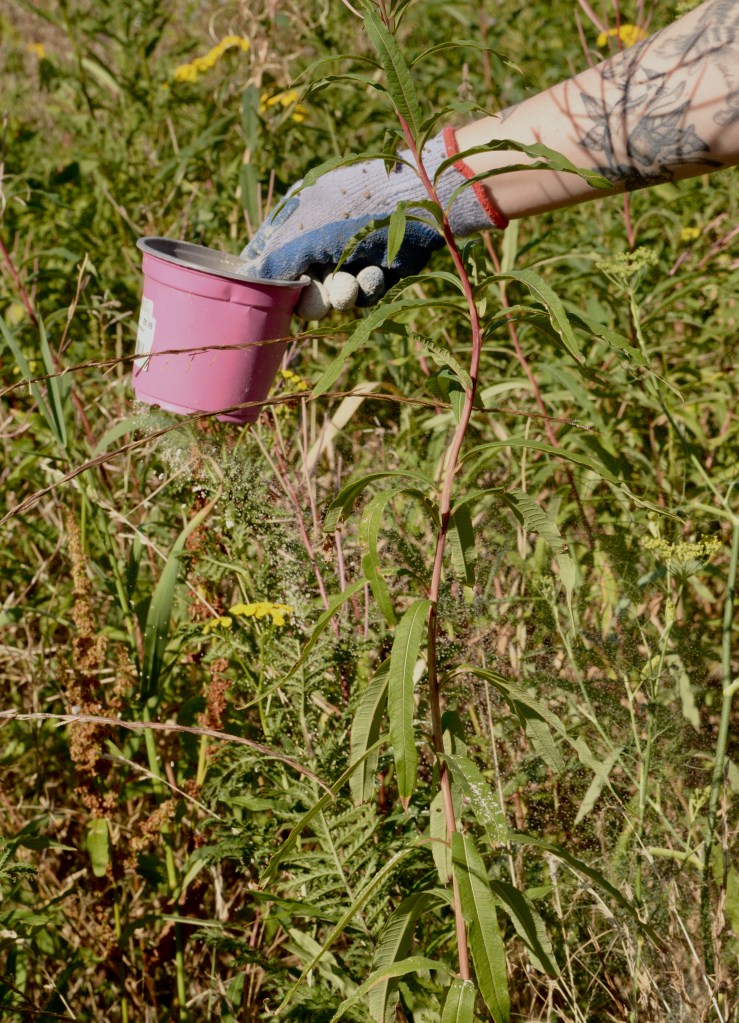
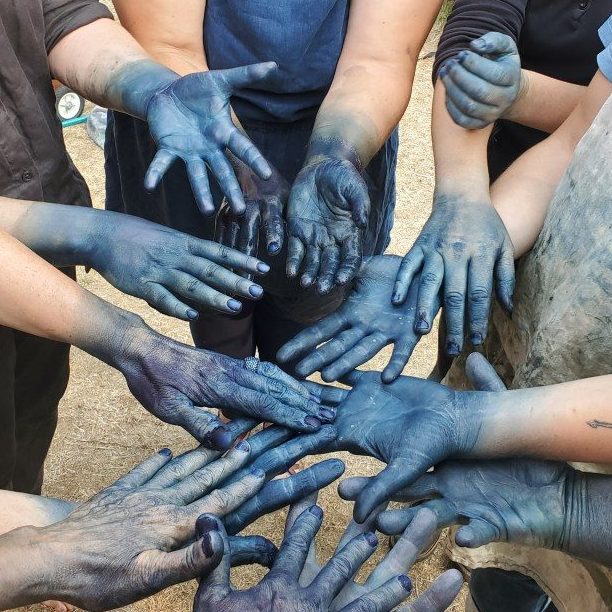
EartHand Gleaners Society uses a community-engaged model for creating environmental art projects with opportunities for research, skill development and skill sharing. Our projects foster multicultural, interdisciplinary collaboration among community members and professionals in the fields of education, sciences and the arts.
We model how to “Be a Producer without first being a Consumer”: to be outdoors working with others, hands in the soil; and being aware of, and depending on, interconnected relationships with the land, other people, and plants. By working with the plants around us using ancestral skills that link all cultures, we inspire participants to discover cultural connections, learn new skills, and see raw materials for creative practices in the world around them, including up-purposed seasonal greenwaste, invasive plants, and textile waste.
We aim to strengthen intercultural connections and relationships to place, and find meaningful ways to acknowledge our Host Nations. Respectful collaboration is the core of our practice


 EartHand Gleaners Society