In light of the pandemic health crisis there are a few things we want you to know about what we at EartHand are doing.
Currently- all programs and in-person community events are cancelled. look for blue “online” labeled events on our calendar- those are new!
Paid program registrants will be contacted if this affects a class you have signed up for, once things resume to whatever “a new normal of functionality’ looks like do know:
~If you have signed up for a paid program and are not feeling well, we will issue a full refund up to the time of class beginning.
~ If you are in a multi-session program and unable to attend part of the program due to illness, we will do our best to meet with you and catch you up on what you missed in a personal tutorial once you are healthy.
~all of our garden gloves will be washed at the end of each session and garden tools sanitized.
~all of our activity sites have hand sanitizer available.
We encourage you to stay home if you are not feeling well, but also see a great benefit to break out of the isolation the current move towards social distancing creates by spending time working in gardens together. We will be practicing best methods for our collective social health; encouraging awareness of 1 meter ‘personal bubbles’, not sharing tools, limited or no hand to hand contact, as well as suspending the usual practice of hugs for those we know and are happy to see again.
We wish you good health and hope to see you in the garden soon.
Do you remember the Natural Dyers Garden Coop program that EartHand offered in past years?
It was one of our favourites and the reason it isn’t offered anymore is because we liked it so much we took the model and invested into ALL our paid programming.
Now, instead of times you are expected to be in the garden – you choose which days for garden work fit your schedule, as well as which parts of the dyers studio- from local fleece to botanical prints.
What fits your creative needs and personal learning journey?
Tending the dye plants generally is grouped in with any stewardship day you see scheduled for Means of Production (MOP). Beyond weeding, path maintenance and fence care; most dye garden work happens in August through October for harvesting.
As with the Dyers Garden Coop model from our past, there is generally equal time investment from the studio workshop to the garden’s care. Each paid class in which you register will have a $ fee as well as # of credits listed. 2 credits required is equal to 2 stewardship sessions.
You can sign up for and complete these stewardship sessions anytime within a 6 month window of the workshop. And note- you can do ANY stewardship or community credit session- it doesn’t’ have to be a dye plant care session!
Dye Dates for Build your Own Adventure: click on any link for more info and registration.
These two sessions are both a chance to help Nicola wash and scour fleece from Barnston Island for our programs. Nicola is incredibly knowledgeable about best practice for fleece washing and how to make it simple for at home processing. If you have never washed a fleece before consider this session. For those with fleece know-how, you will enjoy stories from Nicolas’ wide range of experience and are sure to learn new tricks.
Each participant will leave with a significant amount (approx 8-12 ounces) of dyed local fleece from the dye pots created. Focus will be spring -seasonal light greens, yellows and pale pinks. See link for further details.
An amazing opportunity to do a deep dive into local textile work from dying fibres to designing a small weaving. Two weekday evenings and a full weekend will leave participants ready to take on new projects as well as the enjoyment of your finished small weaving. Follow the link for more detailed information about this program.
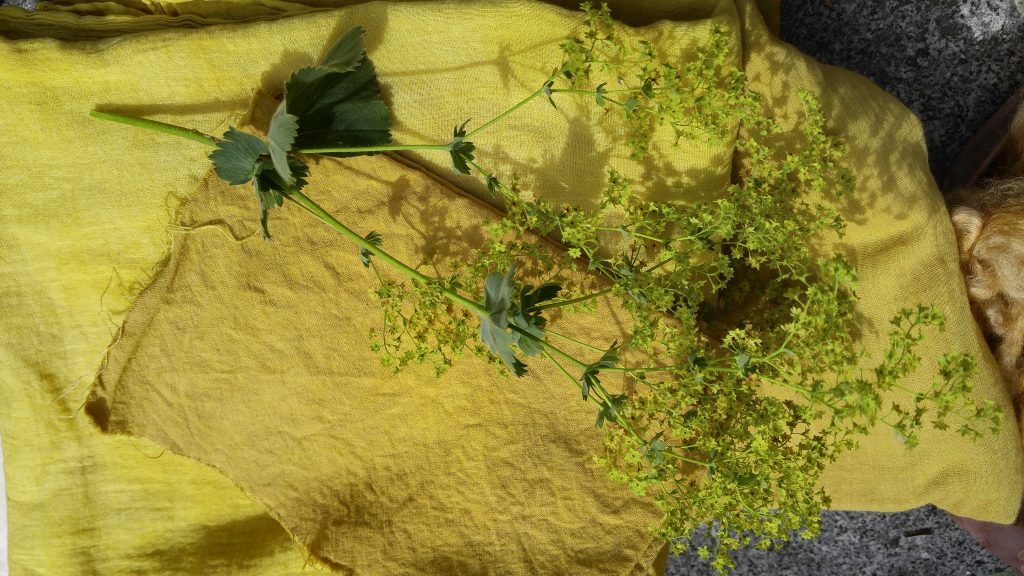
Including both BYO garments for the dye pot and cotton fabric panels that are provided pre-mordanted in alum, this session allows for easy and creative play with local seasonal colour. A simple beautiful way to create prints on cloth and clothing, this method is a great introduction to the world of natural dyes and will teach a simple iron mordanting method.
To be Announced:
Autumn woolly dye pots to be scheduled for mid late October.
Such great conversations and time working together in January, we wanted to keep the conversation going!
The next three weeks find us back at Andina- be sure and get your ticket for each evening at least the night before to help us be accurate in our table booking.
The next few sessions Amy and Sharon will coordinate ‘conversation pods’ around some of the most popular topics so far- from growing our maker needs, participating in local climate actions, and knowledge sharing for specific areas of interest- bring your own topics and conversation starters.
We are super excited to bring in a soil expert to aid in our understanding what happens under our feet in the garden!
This workshop gets into soil theory, then takes us through putting theory into action focusing on areas between the willow and hazel currently suffering with erosion issues at the MOP garden
Saturday April 25th 9am-5pm
Trillium North Park and Means of Production Garden
$70- no stewardship credits are required for this workshop
This full day provides an intensive introduction to the fascinating and intimate relationship between plants and soil and integrates both theory and practice into the day. Participants will learn how to boost their garden’s health by supporting the ecological processes that living soils provide. Learn how to amend your soil by teaming with the microbes in properly-made compost and compost extract. Develop a better understanding of plants, roots and soil interactions.
The morning begins with theory and soil intro at our Trillium North site and after lunch the practical component will include preparation and planting of one of the sites at Means of Production Garden. The day includes two short breaks and a break for lunch and travel from 12noon-1.45.
Please bring something to share for a potluck lunch
The two sites are about 15 minutes apart by bicycle or 10 minutes by car- registrants will be contacted 3-4 days prior to workshop to best coordinate travel options for the group. Trillium North Park is located on the southern edge of Strathcona, MOP is located in Mount Pleasant on the western edge of North China Creek Park
Thank you to Vancouver Park Board: Arts Culture and Engagement for partial sponsorship of this program.
About the Instructor: Jo Tobias is a regenerative soils consultant, permaculture practitioner, educator, and owner of RootShoot Soils. She has been training under Dr. Elaine Ingham of Soil Food Web for five years while working directly with farmers to regenerate the life in their soil. Find out more at www. Rootshootsoils.com
Have you been a part of our community this year? We would love to have you join us for stories about the past year and the plans for the year ahead.
We gather around a wood stove and Sharon shares stories of the past year- what has been learned and how our community is growing and evolving. Expect tea and snacks, laughs and hand work. Dress as if you were spending a day at a cabin somewhere up the coast.
We are honoured to once again have access to the off grid eco-pavilion in the centre of Strathcona Community Garden for our AGM, it is a beautiful space to spend a winter afternoon
Space is limited, we ask you to confirm attendance by taking a ticket as a form of registering.
Registered members will receive AGM documents by email 1 week prior to meeting as well as clear instructions for finding us at the eco-pavilion.
We are super excited to have Delmar Williams back to teach with us this winter!
Delmar is an incredible skill and knowledge holder and time working with Delmar is always worthwhile. This session is very special, Delmar is bringing his portable wood burning stove, we have a fire permit for the afternoon, and get to enjoy each others company for a winter afternoon around the fire learning carving principles with a common camping knife and finish the spoon bowl by coal burnout! Class is Saturday afternoon Feb. 8th, cost is $68 and includes old growth cedar provided by Delmar and a knife for class use. find out more and register here https://earthanddotcom.wordpress.com/events/cedar-spoon-carving-with-delmar-williams/
Delmar Williams is from the Squamish and Lil’wat Nation. He has grown up within his community and with elders who still speak their traditional language and sing traditional songs. As a child, his family would fish the Fraser River every year to sustain themselves through the year. He carries the ancestral name of Banksht from his mother’s family and the name Xwepilkinem (his father’s ancestral name) which refers to the man who slayed the two headed sea serpent. He continues to learn and grow his knowledge around ancient technologies and ways of knowing.
Delmar is a Big Game Hunt Guide in northern British Columbia and has worked with Outward Bound Canada as a professional guide for several years. Most recently, he has taught with the Seymour Longhouse program where instructors teach fire, cooking with fire, building tripods; making slahal sets (traditional native gambling game); hide tanning; basketry; and plant gathering. In the North Vancouver School District #44 he teaches high school students about wilderness survival, fire by friction, and ancient technology.
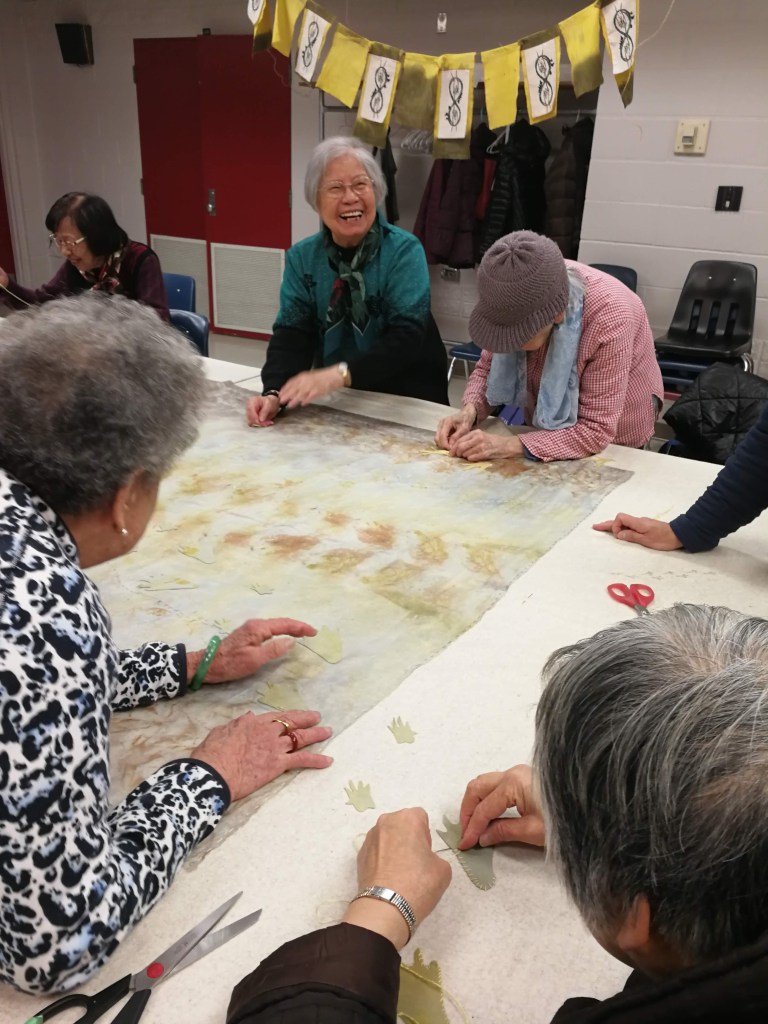
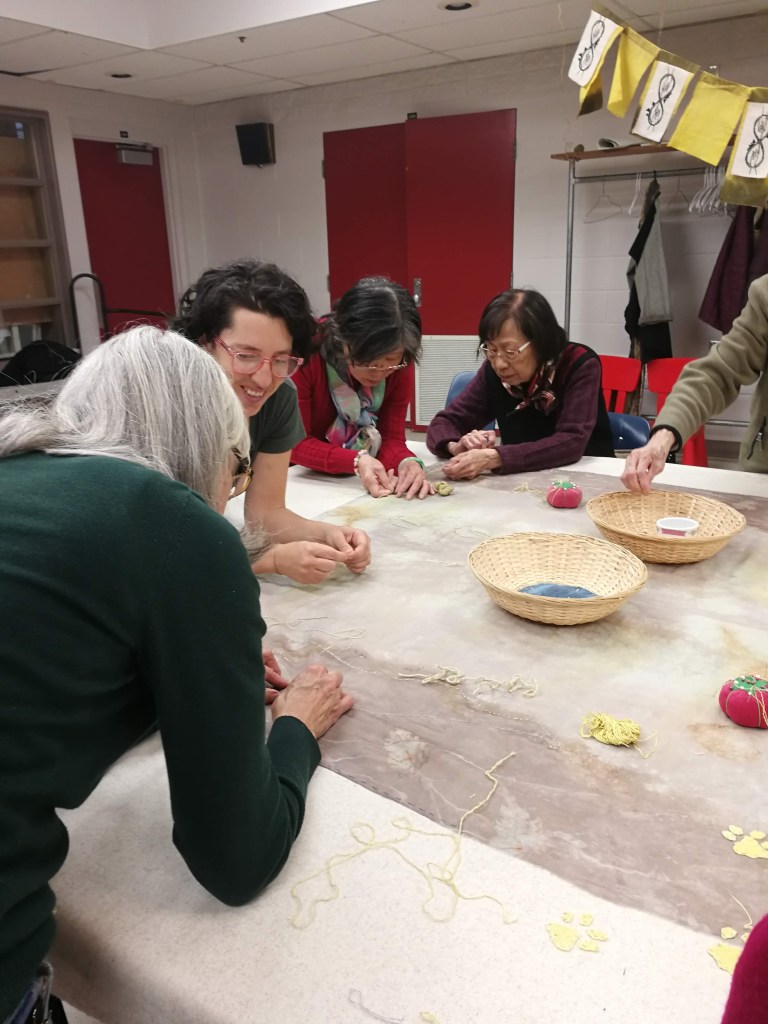
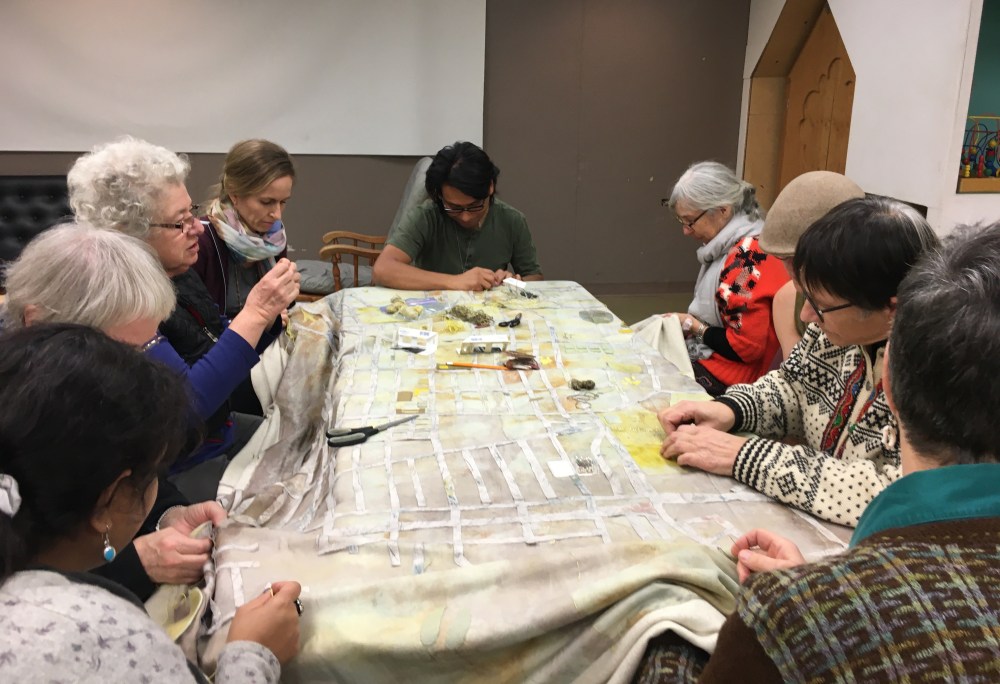
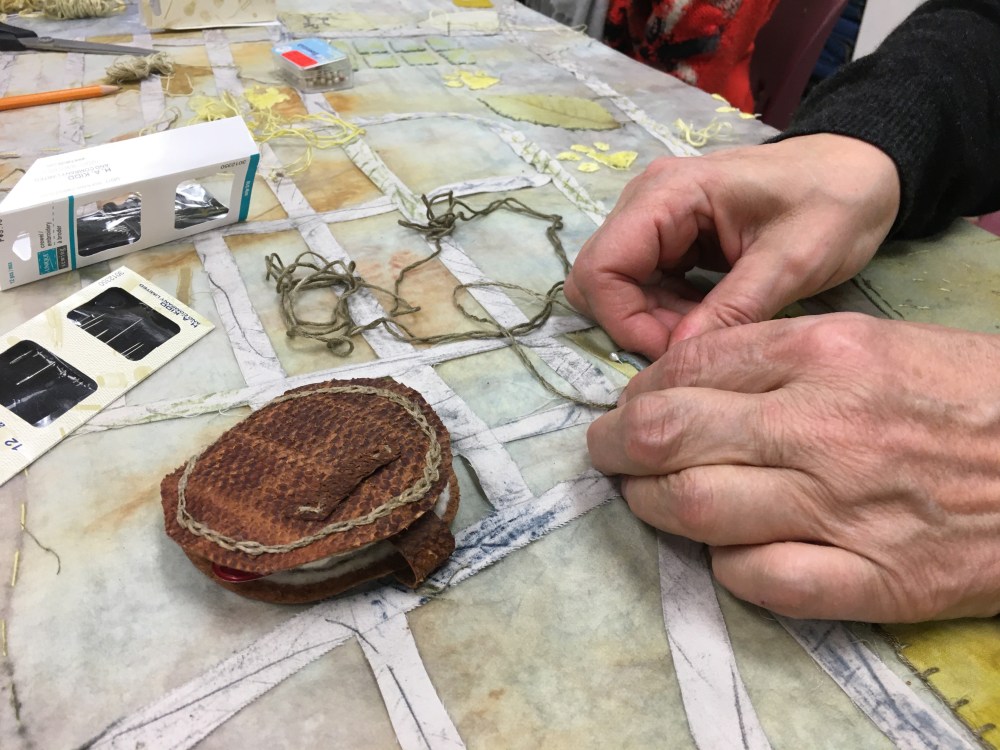
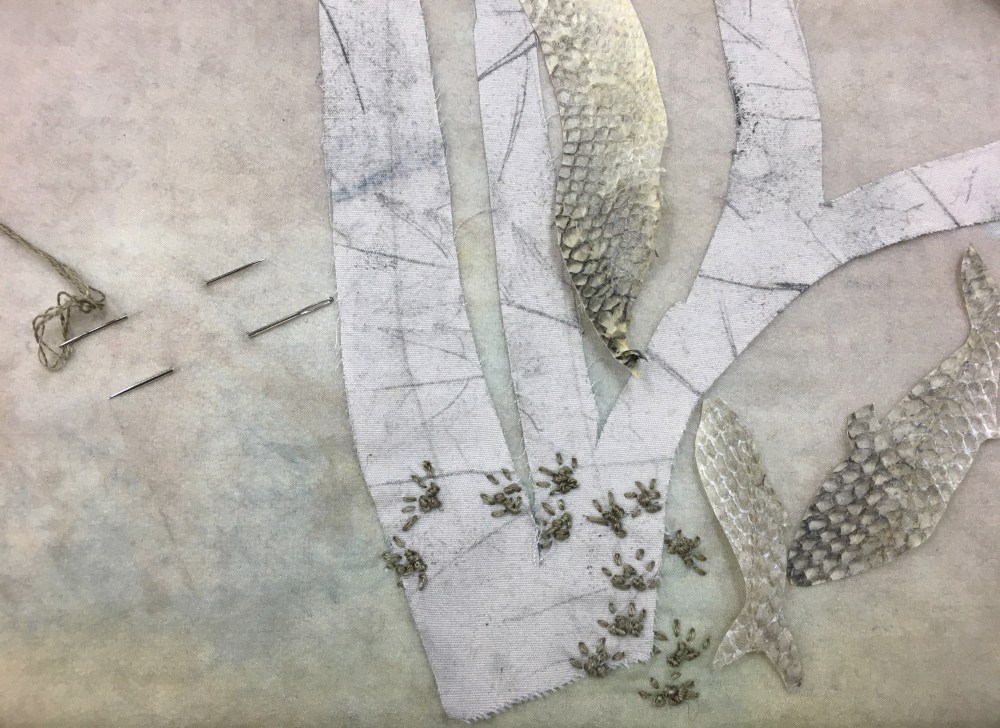
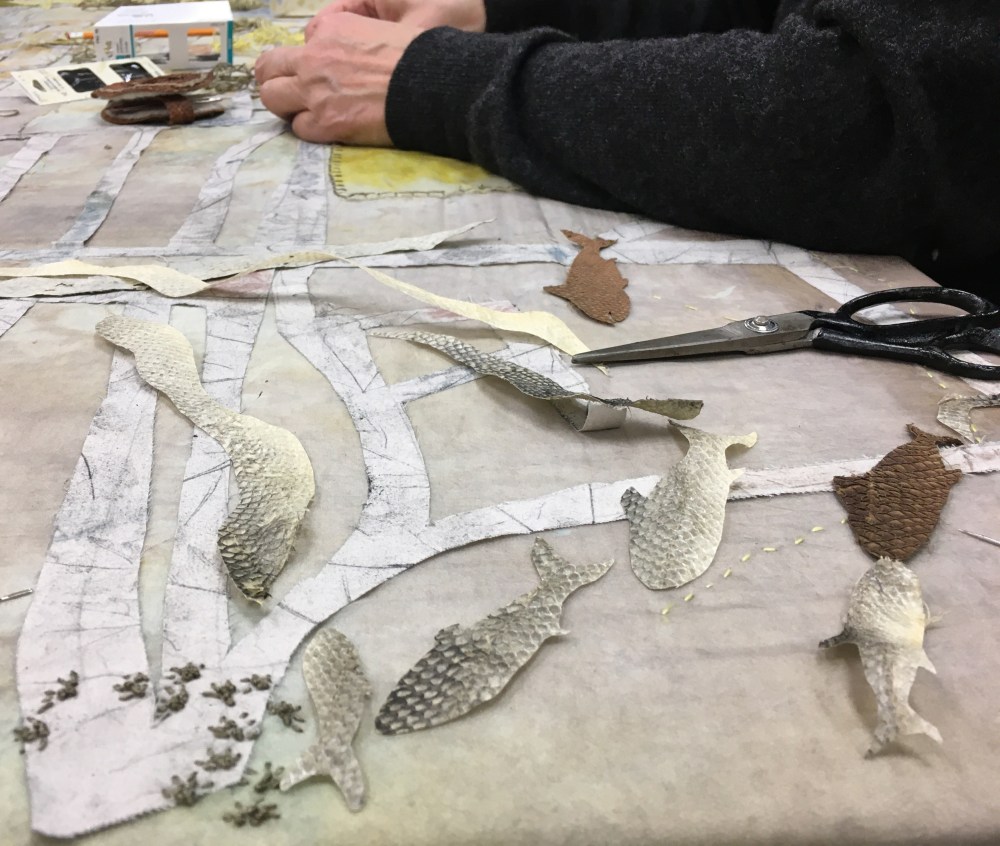
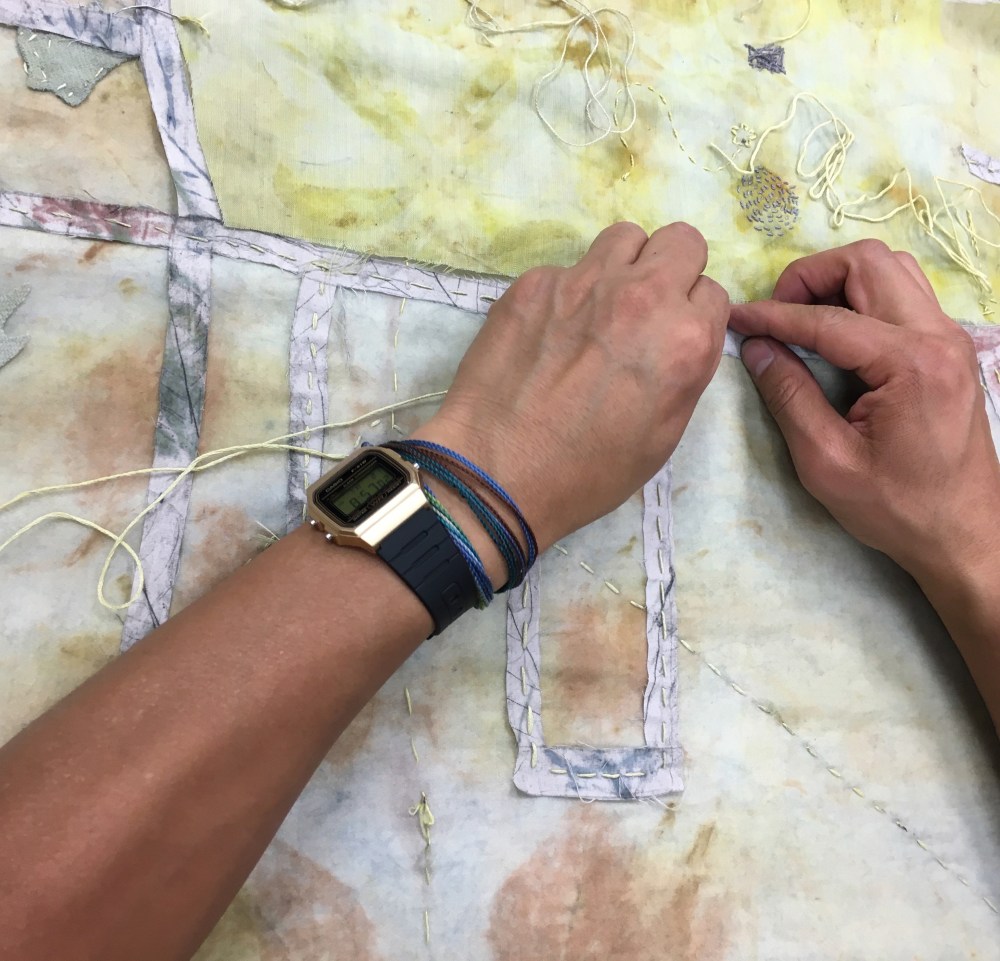
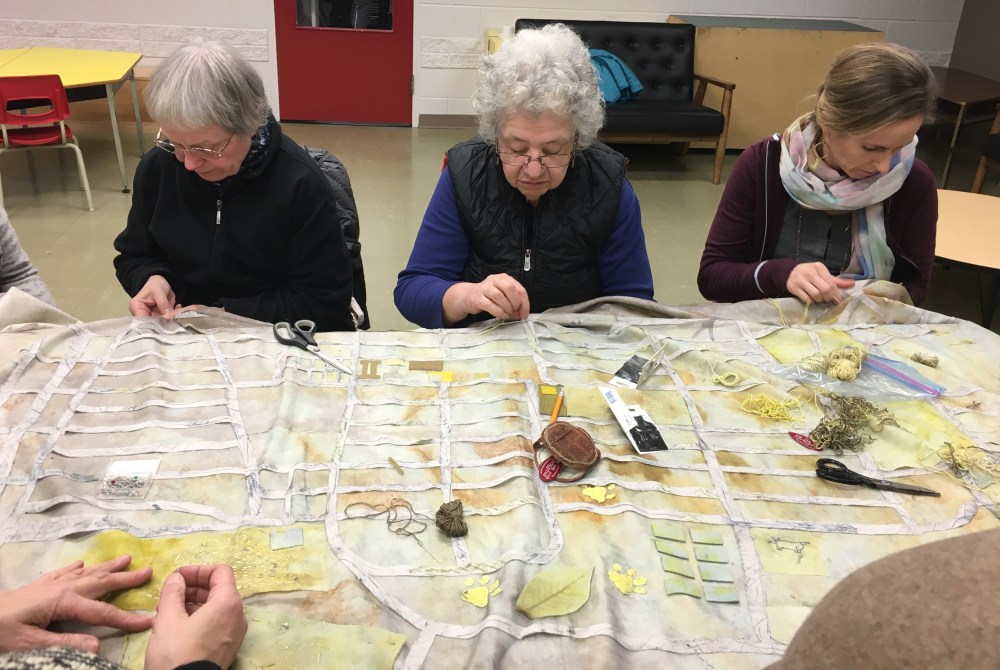
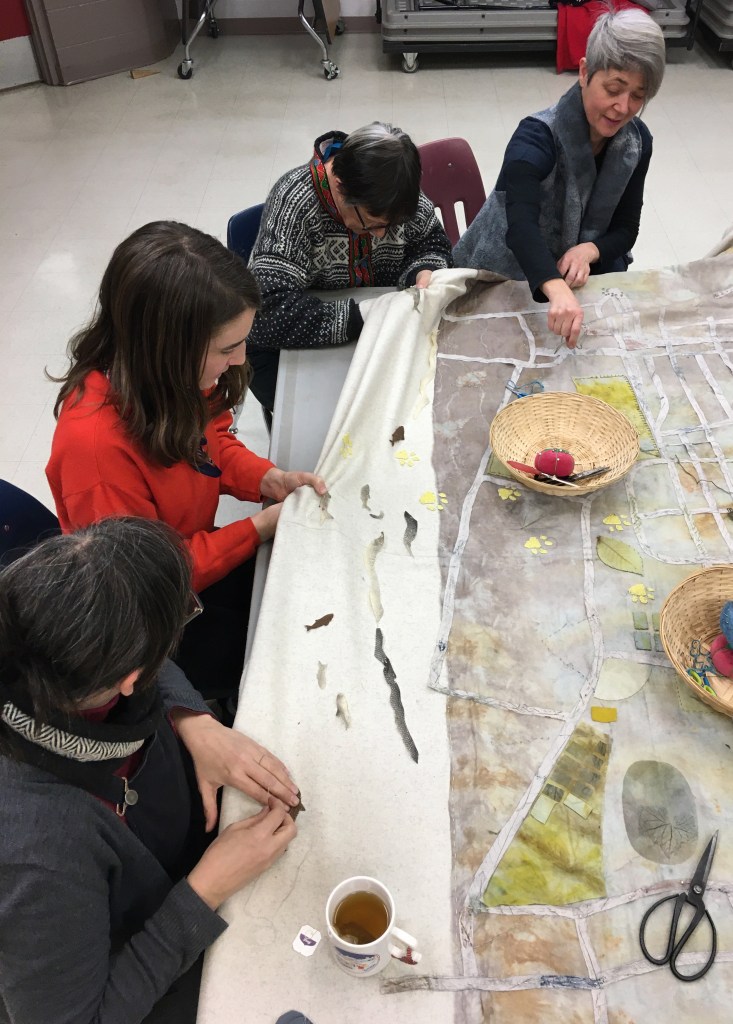
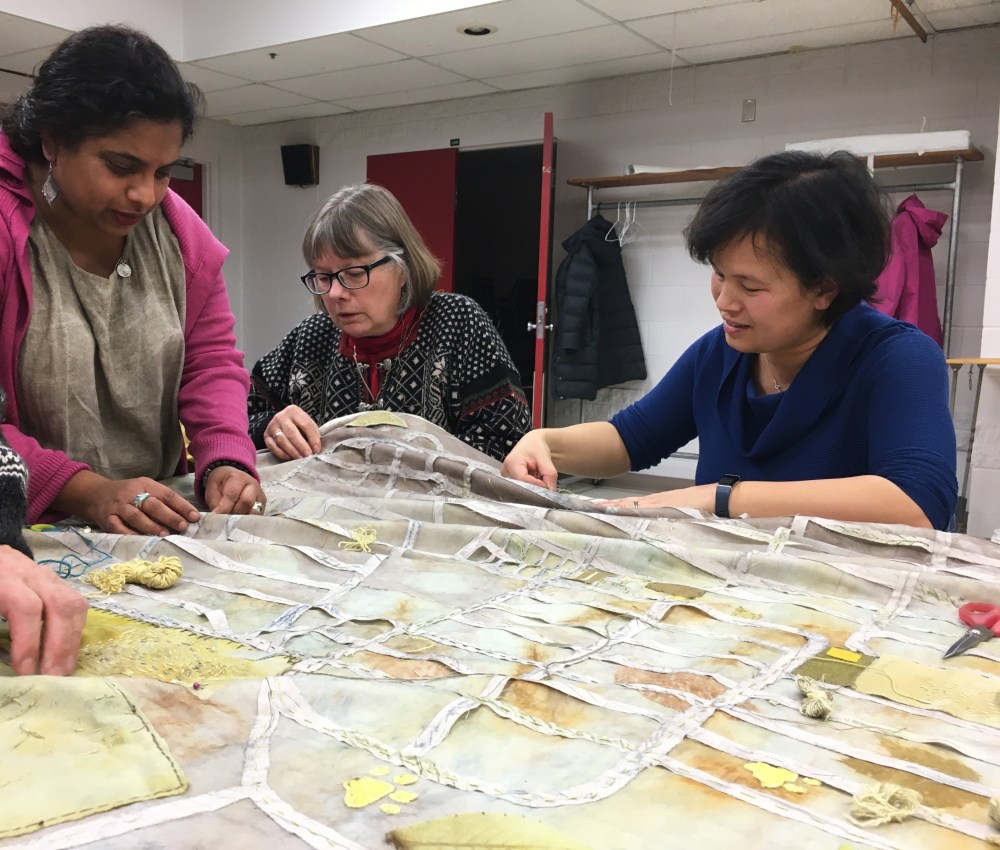
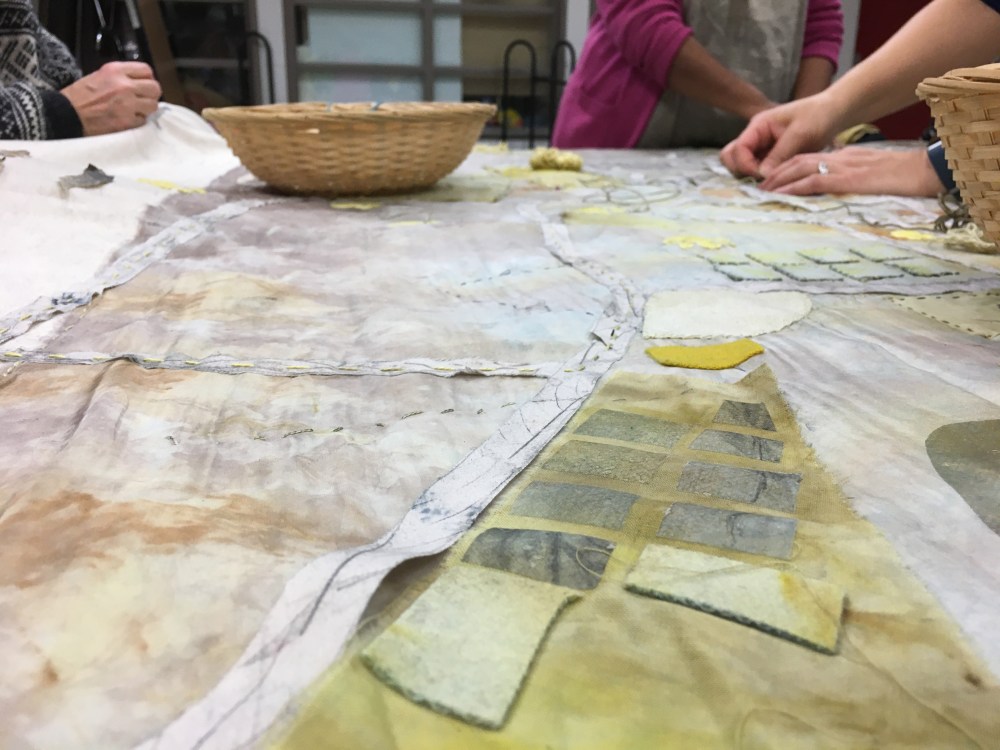
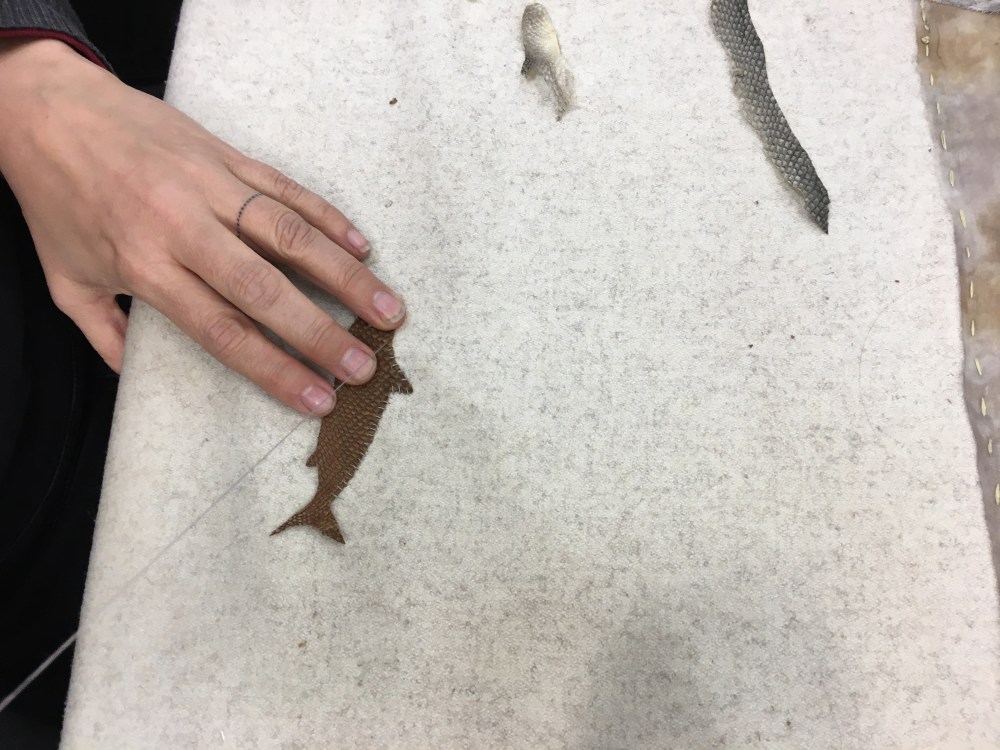
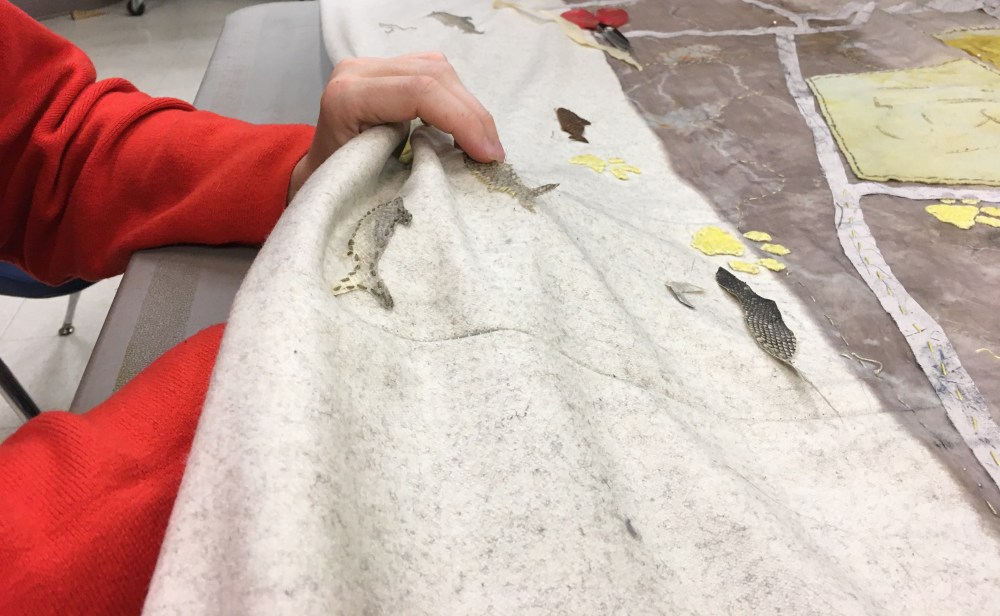
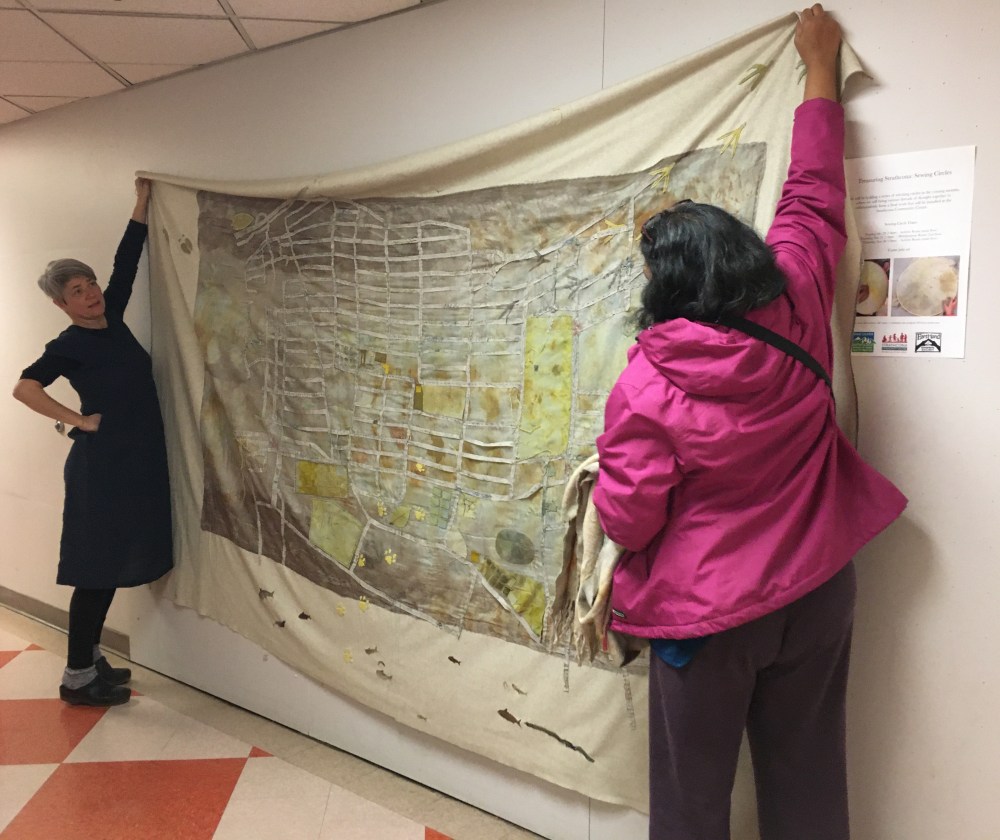
Over the past 6 weeks we have been working together to create a collaborative textile artwork that will live at the community centre after our 2019 residency is completed. The piece is made from layers of cloth that were dyed and marked (by plants growing throughout the neighbourhood) during our summer Plant & Dye walks, MacLean Park Movie Night, the Strathcona Harvest Festival and more. These cloth pieces, along with salmon skin leather made by Janey Chang, were stitched together, and sewn upon, by dozens of community members and friends to form a map of the neighbourhood.
The idea of mapping Strathcona in this way came out of conversations that were had over the course of the year, dialogues that explored how cartographies might be reimagined. The project evolved organically from the starting point of community asset mapping (ideas of maps and notes on paper), to painting and imagining “in the long ago” on wood (with Janey Chang and Jay Peachy), and celebrating the present with a mural on the shipping containers created by Alex Ramirez and the Summer Heat youth group. The final piece in this project, a textile map, is another iteration of these ideas, our intention being to reflect the many histories that are held in this vibrant place, a mingling of plant and animal presence alongside human life.
This chapter in the Artist in Communities residency has been so affirming. Thank you to all who joined our sewing circle events, your time, skill and generosity were greatly appreciated. As part of the Lantern Festival on December 21, we will be celebrating the culmination of our residency at the Strathcona Community Centre. Join us and the Secret Lantern Society for a creative evening of community celebration!
December feels the perfect time to have launched this project.
As the season seems to push buying more of anything from all directions, it feels very inspiring and honest to sit with others and contemplate how to best fix or remake what we already have.
Huge thanks to the Roundhouse Community Centre for hosting us in the lobby and to those that came out to mend with us!
Amy Walker of Makemobile joins Sharon Kallis, plus invited friends, colleagues and passers-by for Stitch and Strategize. Check out this page for more information about this project.
Conversation and Clothing
Fridays Dec 6, 13 & 20 9am-12noon
Roundhouse Community Centre, 181 Roundhouse Mews
Friday Dec 27 11am-2pm
Trillium Park , SW corner of Malkin and Thornton streets
Sharon and Amy embark on a slow-clothing exchange; making and mending for each other, sharing skills and materials. Join them for conversations about textiles, listen to podcasts, learn mending and making methods and generally be inspired in ways to extend the life of your wardrobe. Free event, no registration required, some mending materials and tools available for use or loan during session if you wish to do your own hand work alongside.
Join Amy and Sharon at Andina for social time in this lovely, well-lit room. Please take a ticket so we’ll know the size of our reservation. Participants are responsible for their own food/beverage purchases and we ask you to please order something from the food or drink menu. Bring your own project and enjoy EartHand comradery on these winter nights! tickets: Jan 14, Jan 21, Jan 28, Feb 4
Fibre Field Studies: Looking at our local second-hand/waste stream cloth ecology
Join Amy and Sharon for an informal cruise of the Value Village aisles. Let’s look together for garments that make good candidates for refashioning- either as a cloth harvest or for pattern hacking. This is an excellent opportunity to learn how to scout a thrift shop if garment hacking for patterns, yarn harvests or reading fibre labels is a mystery for you. Participants are responsible for making their own purchases.
Back by popular demand! This program continues to be one of our most popular so we are thrilled to offer it again this winter.
Fish skin leather is an ancient skill that was once common among ocean and freshwater communities in the Northern Hemisphere. It is a beautiful textile that can be tanned in different ways to create a strong leather for clothing, pouches, wallets, footwear and art. In this class we will use the bark tanning method resulting in soft, burgundy-toned skins. You will have an opportunity to prepare between 1-5 or more fish skins into leather depending on the speed you work.









 EartHand Gleaners Society